
REGIONAL OPERATIONS · E-INVOICING READINESS
Plan e-invoicing across Oman, the UAE and Saudi Arabia
Give each entity its own applicability decision, source record and acceptance evidence. Then coordinate shared data, systems work and people through one reviewable programme.
THE SHORT ANSWER
Start with an entity-by-country register. Confirm the relevant financial measure, period, scope, authority notice and provider obligations before setting dates. Reuse useful test designs, but execute and review them for each applicable entity and route. This guide organises management work; it does not determine tax obligations or certify compliance.
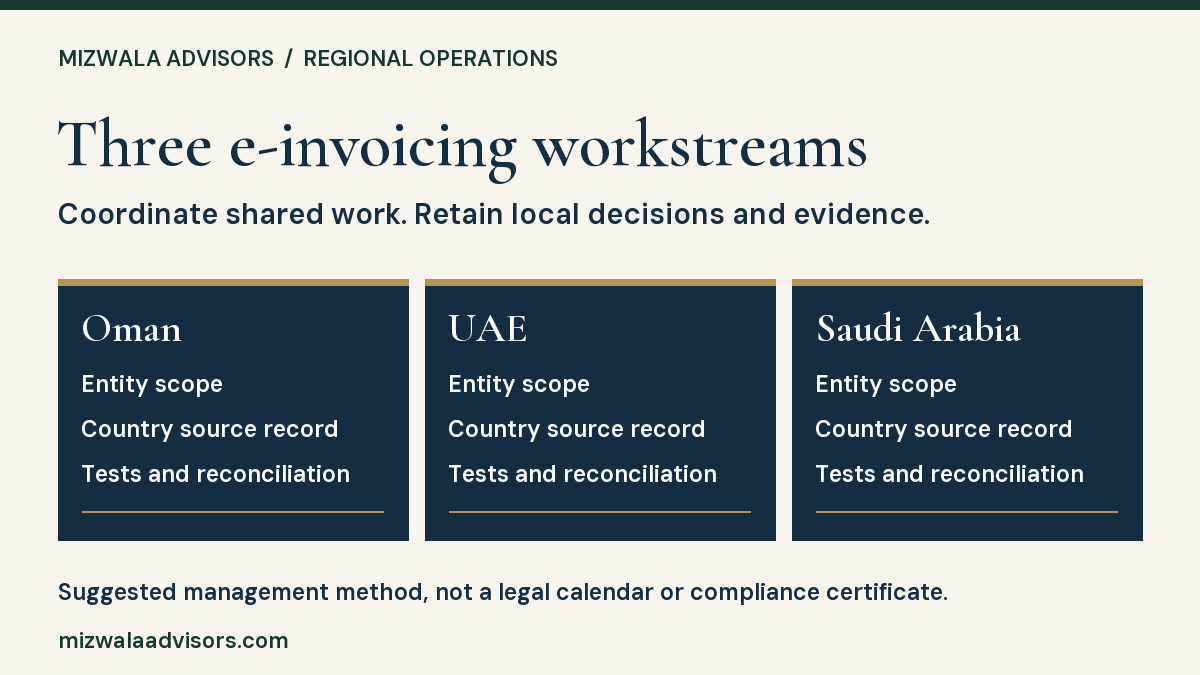
Entity scope · Country source record · Tests and reconciliation
Entity scope · Country source record · Tests and reconciliation
Entity scope · Country source record · Tests and reconciliation
Define the entities before comparing calendars
A regional finance team may have a shared enterprise resource planning (ERP) system, common customer records and one systems partner. Give every legal entity and relevant transaction route a separate line in the readiness register. A group-level status can hide an unresolved local obligation or a provider contract that covers only part of the business.
Record the country, accountable business owner, relevant registration and transaction scope, source links, source version, assessment reviewer and next review date. Keep confidential records in the organisation’s approved systems; this public guide and worksheet need no credentials or tax identifiers.
Coverage: this guide uses selected official planning triggers in Oman, the UAE and Saudi Arabia. It is not a complete legal calendar or an applicability opinion. Other cohorts, exclusions and detailed technical rules require their own review. Bahrain, Kuwait and Qatar also need separate current local assessments; no position on their requirements is inferred here.
Use a separate source check for each country
Snapshot checked: 6 November 2026. The following are selected planning inputs, not a test that assigns your business a statutory date.
Oman: supplies and the relevant periods
The current OTA FAQ, question 5, tests supplies in 1 April 2026–31 March 2027 and expected supplies in 1 April 2027–31 March 2028. Exceeding OMR 5 million in either points to 1 April 2027; otherwise it specifies 1 October 2027. Read its VAT-group, non-resident and included-supplies instructions before assessing a figure.
Use the Oman readiness guide for the linked decision and a deeper operational example.
UAE: provider appointment and implementation
The MoF’s 27 September 2026 update gives persons subject to the system with annual revenue of AED 50 million or more an accredited service provider (ASP) appointment deadline of 30 October 2026 and an implementation date of 1 January 2027.
The appointment date had passed at this guide’s check date. If this cohort may apply, obtain prompt qualified guidance on the position and next action. This preparation plan grants no extension. Check other cohorts, exclusions and amendments through the current MoF legislation hub.
Saudi Arabia: retain the actual wave notice
ZATCA’s rollout guidance uses taxpayer waves for Phase 2 and says notification is at least six months in advance. Match the entity’s position and notice to the applicable requirements.
For example, its 24 July 2026 Wave 25 announcement specifies VAT-subject revenue above SAR 187,500 during 2022, 2023, 2024 or 2025, with integration by 1 February 2027. That is a wave-specific example, not a universal deadline or a statement that it is the latest wave.
Keep supplies, revenue and VAT-subject revenue as separately defined measures. Preserve each source’s currency, comparison operator and measurement period. A converted group sales number is not a substitute for the required local assessment.
Keep a decision trail when source versions differ
During this research, a search extract described the earlier phase calendar. Opening both the alternative official FAQ route and the current Fawtara FAQ showed the updated 2027 supplies test. Check the primary page itself, retain the version reviewed and resolve any remaining conflict with the appropriate adviser or authority.
Record what changed, which entities could be affected, who reviewed the difference and how the decision reached the project team. Separate the legal assessment record from the project schedule, then connect them through a controlled change reference. A vendor slide or an undated search extract should lead back to its primary source.
Give every date an owner and a review trigger: a new authority notice, amendment, provider-status change, restructuring or revised financial information may require reassessment. These are suggested management controls, not a claim that every trigger changes the legal result.
Coordinate common work with local acceptance evidence
Agree common data definitions and ownership where that helps the business. Then document local mappings, document types, provider or authority exchanges, responses, ledger treatment and retrieval requirements. The relevant specialist and provider must validate the actual country requirements.
The UAE programme hub describes structured invoice data and exchange/reporting through its model. A PDF-looking output alone cannot demonstrate the underlying exchange, status handling or accounting result. Build evidence around the real route and responses.
- Data: identify the source field, owner, validation and correction process.
- Connection: confirm the actual entity, provider arrangement and environment being tested; protect production credentials.
- Operations: rehearse a rejection, an uncertain outcome, a credit note, recovery and retrieval using the agreed local rules.
- Reconciliation: account for submitted, held, accepted, rejected and unresolved records using documented status mappings and cutoff times.
- Decision: record the evidence, material open issues, responsible approvals and ongoing support ownership.
These are management review categories. They are not official status codes, technical specifications or a prescribed universal control framework.
A fictional programme: reuse designs, then test each route
An invented group plans one entity workstream in each of the three countries. For a deliberately simplified management exercise, it defines eight common test designs and four local designs for each workstream. The common designs cover data quality, approval, posting totals, credit-note reference, duplicate handling, access, recovery and retrieval; the local designs are placeholders to be specified and validated for the actual regime.
There are 8 + (4 × 3) = 20 distinct designs, but (8 + 4) × 3 = 36 planned executions. Reusing a design reduces drafting work; it does not remove the need to execute and evaluate it on the relevant entity and route.
Suppose 30 executions have been attempted: 27 have documented completion evidence, three remain unresolved and six are still unrun. The attempted-test completion rate is 27 ÷ 30 = 90%, while recorded closure across the planned set is 27 ÷ 36 = 75%. There are nine planned executions without closure evidence. The table reconciles the count; it does not establish readiness or compliance.
A single material unresolved case can outweigh a favourable percentage. Expand this small fictional test set to the real transaction mix and requirements. Keep severity, coverage, evidence quality and approvals alongside counts.
| Management status | Executions |
|---|---|
| Documented completion | 27 |
| Attempted, unresolved | 3 |
| Not yet run | 6 |
| Total planned | 27 + 3 + 6 = 36 |
Invented planning labels and counts, not official response codes or a compliance benchmark. Closure evidence is missing for 3 + 6 = 9 planned executions.
Turn the register into an accountable next step
Take the worksheet into a discussion with the entity’s tax adviser, finance owner, technology team and provider. First resolve the applicability and date record. Then agree the operational scope, inputs, test evidence, decision responsibilities and the work required to close material gaps.
Mizwala can help frame a management brief for process and controls readiness or finance systems and reporting work. Tax determinations, technical implementation, accreditation and compliance certification require the relevant expertise and a separately agreed scope. No provider purchase or implementation commitment is implied by this guide.
TAKE THE NEXT STEP
Use the worksheet.
Open the worksheet, type your notes in the fields and use your browser’s Print command to keep a PDF or paper copy. Calculations are manual. Entries stay in your browser and are not submitted to Mizwala; reload or close without saving and they may be lost.
Questions worth checking
Can one ERP rollout settle all three country decisions?
Keep each entity’s applicability, local mappings, provider arrangements and acceptance evidence explicit. Shared technology can coordinate work but does not make those decisions interchangeable.
Is Wave 25 the date for every Saudi business?
No. It is the specific official example cited here. Review the relevant taxpayer criteria, actual notice and current ZATCA instructions. The guide does not identify your wave.
Does the worksheet determine a deadline or replace tax advice?
No. It records the assessment, sources, owners and project evidence. Obtain the appropriate qualified advice and authority clarification for the actual entity and transactions.
Sources & scope
Primary pages checked on 6 November 2026. The selected dates and measures are attributed above; scope, exclusions, further amendments and entity-specific obligations require qualified review. The programme method and fictional calculations are Mizwala educational illustrations. AI-assisted research and writing; no independent tax or native Arabic editorial review is claimed. Linked authorities do not endorse Mizwala.
- Oman Tax Authority — current Fawtara FAQ, question 5
- Oman Tax Authority — alternative official FAQ route
- UAE Ministry of Finance — 27 September 2026 implementation update
- UAE Ministry of Finance — current programme and legislation hub
- ZATCA — rollout phases and taxpayer notification
- ZATCA — Wave 25 announcement, 24 July 2026
This is general management information. Adapt it to your circumstances and obtain appropriate professional advice before relying on it for a material decision.